
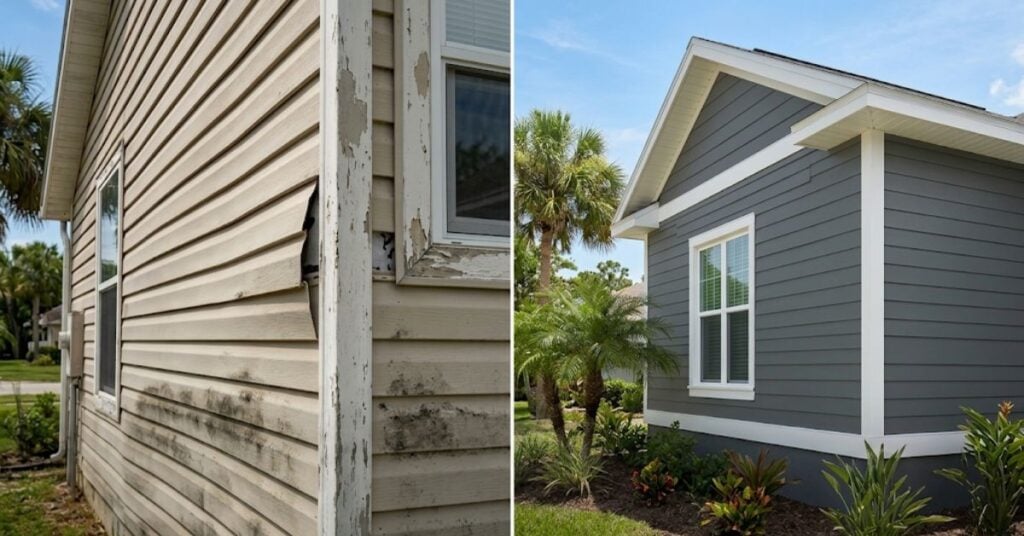
Your siding is your home’s first line of defense. It protects your walls, insulation, and structural framing from Tampa Bay’s relentless heat, humidity, and storm season. When siding begins to fail, it rarely happens all at once, it happens gradually, through a series of warning signs that many homeowners miss or dismiss until the damage becomes serious and expensive to address.
In Florida’s climate specifically, siding deterioration moves faster than in most other parts of the country. The combination of extreme UV radiation, year-round high humidity, salt air in coastal areas, and the periodic impact of tropical storms creates conditions that accelerate every failure mode in siding materials, whether you have wood, vinyl, older fiber board, or even improperly installed fiber cement.
This guide covers the seven most critical warning signs that Tampa FL homeowners should never ignore, and what each one tells you about the condition of your home’s exterior envelope.
| 📌 Quick Check: How Old Is Your Siding? If your Tampa home has wood siding older than 15 years, vinyl siding older than 20 years, or fiber board (like Masonite or Louisiana-Pacific Inner-Seal) older than 10 years, read every sign in this guide carefully. These materials have well-documented failure timelines in Florida’s climate, and there’s a good chance at least one of these signs already applies to your home. |
Sign 1: Visible Warping, Buckling, or Waves in Your Siding Panels
| This is one of the earliest and most visible signs that your siding is failing. When vinyl siding panels warp, buckle, or develop a wavy appearance, particularly on south and west-facing walls that receive the most direct Florida sun, it means the material has been repeatedly expanding and contracting with temperature changes to the point where it can no longer return to its original shape. In Tampa’s heat, this process happens significantly faster than in cooler climates. |
Warped or buckled siding panels are not merely a cosmetic issue. When panels pull away from the wall or develop gaps at their edges, they create pathways for wind-driven rain to penetrate behind the siding, the single most common cause of moisture damage, rot, and mold in Tampa Bay homes. If you notice any section of your siding that looks wavy, bowed, or no longer lies flat against the wall, it warrants immediate professional inspection.
Fiber cement siding does not warp. It’s dimensionally stable in Florida’s heat and thermal cycling, which is one of the primary reasons it’s the material of choice for homeowners who have dealt with warped vinyl and never want to again.
Sign 2: Rot, Soft Spots, or Spongy Areas on or Near Your Siding
| Soft spots near the base of your siding, around windows and door frames, or at corner boards are a serious red flag. In Florida’s year-round humidity, any organic material in or behind your siding, wood fiber, OSB sheathing, or wood framing, that has been exposed to moisture will begin to rot. Once rot establishes itself in a wall cavity, it spreads faster than most homeowners realize. |
You can often identify soft spots without removing siding, simply press firmly on sections of your exterior wall with your fist or a screwdriver handle. Areas that feel spongy, hollow, or that flex under pressure when they shouldn’t indicate that the structural material beneath the siding has been compromised by moisture. This is not a repair situation, by the time rot is detectable from outside, it has almost always progressed well beyond the visible surface.
Rot in exterior walls is also a health concern. Wet, rotting wood is an ideal environment for mold growth, and mold spores that develop in wall cavities can enter the home’s interior air through electrical outlets, light fixtures, and any gaps in the wall assembly. Tampa Bay’s warm, humid climate makes this an especially serious risk compared to drier climates.
Sign 3: Paint That Won’t Stay On, Frequent Peeling, Blistering, or Bubbling
| If you’ve repainted your home’s exterior within the last five years and the paint is already peeling, blistering, or bubbling, the problem isn’t the paint. In Florida, exterior paint that fails prematurely almost always indicates that moisture is present in or behind the siding surface. The moisture migrates through the siding and lifts the paint film from underneath. |
This sign is particularly common on older wood siding and on fiber board products like Masonite and certain LP Inner-Seal products, both of which have been the subject of class action lawsuits in Florida specifically related to premature paint failure caused by moisture infiltration into the wood fiber core. If your Tampa home has fiber board siding and you’re dealing with recurring paint failure, replacement, not repainting, is the appropriate solution.
Repeated repainting of failing siding is one of the most common deferred maintenance patterns we encounter on Tampa Bay homes. Each repaint temporarily restores appearance but does nothing to address the underlying moisture problem, and every passing season allows that moisture to do more structural damage to the wall assembly beneath. James Hardie fiber cement with ColorPlus factory finish eliminates this cycle entirely, no repainting required for fifteen or more years, with the finish warranted directly by the manufacturer.
Sign 4: Rising Energy Bills, Especially During Tampa’s Long Summer
| If your air conditioning bills have been creeping up year over year without a clear explanation, and you haven’t added square footage, replaced appliances, or changed your usage habits, your siding may be a contributing factor. Siding that has developed gaps, lost its seal at joints and penetrations, or that was installed without proper insulation behind it allows conditioned air to escape and unconditioned outdoor air to infiltrate. |
In Tampa’s climate, where air conditioning runs for eight or nine months of the year, this is a genuinely meaningful expense. The energy efficiency impact of compromised exterior siding is often underestimated by homeowners who attribute rising utility bills to equipment aging or rate increases. A proper siding replacement with fiber cement panels and a continuous insulation layer can make a measurable difference in cooling efficiency, particularly in older Tampa Bay homes that were built before modern energy codes.
James Hardie fiber cement siding, installed with proper weather-resistant barrier and sealed joints, creates a significantly tighter building envelope than aging vinyl or wood siding. Many Fresh Start Exteriors customers report noticeable improvement in their cooling bills following a full siding replacement, an additional return on the investment beyond the aesthetic and structural benefits.
Sign 5: Visible Cracks, Holes, or Gaps, Especially Around Windows and Doors
| Cracks in siding panels, gaps at butt joints between boards, or openings around window and door frames are direct invitations for water, insects, and conditioned air to move in and out of your wall assembly. In Florida’s wind-driven rain environment, where tropical storms push water horizontally at hurricane speeds, even a small gap in your siding system can allow significant water infiltration in a single storm event. |
Pay particular attention to the caulk lines around every window and door frame on your home’s exterior. Caulk is a consumable component of your exterior envelope, it degrades under UV exposure and thermal cycling over time. On Tampa Bay homes, caulk at windows and doors typically needs inspection and touch-up every three to five years. Caulk that has cracked, shrunk away from the frame, or turned chalky and brittle is no longer providing a water seal.
Cracks in the siding panels themselves, as distinct from caulk line failures, indicate that the material has experienced structural stress beyond normal movement. On vinyl siding, this often results from impact or from the brittleness that develops after years of UV exposure. On older fiber board products, panel cracking is a sign of moisture infiltration that has compromised the structural integrity of the panel itself. Neither is a situation where patching or caulking provides a durable long-term solution.
Sign 6: Mold, Mildew, or Fungal Growth on Your Exterior Walls
| Some surface mold or mildew on exterior siding is a fact of life in Tampa Bay’s humid climate, it can be cleaned from most siding surfaces without indicating a serious problem. However, mold or mildew that returns quickly after cleaning, that appears in large patches, or that seems to come from inside the wall rather than just sitting on the surface is a sign of a more serious moisture infiltration problem. |
Mold that is established inside the wall cavity, behind the siding, often becomes visible on the interior walls of the home before it’s apparent on the exterior. If you notice musty odors in rooms adjacent to exterior walls, dark staining on interior drywall near windows or at the base of walls, or any bubbling or separation of interior paint, these are signs that moisture has fully penetrated the wall assembly and mold remediation may be required alongside the siding replacement.
It’s also worth noting that the surfaces of certain siding materials are more hospitable to mold and mildew growth than others. Fiber cement is one of the least hospitable surfaces for mold growth, its non-organic, non-porous composition gives mold spores nothing to attach to or feed on. Homeowners who replace wood or vinyl siding with James Hardie fiber cement consistently report less exterior mold and mildew maintenance than with their previous siding material.
Sign 7: Storm Damage, Even If It Looks Minor
| After any tropical storm, hurricane, or significant wind event in Tampa Bay, your siding deserves a professional inspection, even if the damage looks cosmetically minor. A single cracked vinyl panel, a section of siding that was pushed inward by wind pressure, or a corner board that is now slightly out of alignment can represent a compromised water seal that will allow moisture infiltration in the next rain event. |
What makes post-storm siding damage particularly deceptive is that the most serious damage is often the least visible. Wind-driven rain events don’t need a visible opening to push water behind siding, they just need a seal that has been weakened by wind pressure or impact. Water that enters a wall cavity during a storm can travel horizontally and vertically well beyond the entry point before it becomes visible as a stain or soft spot.
If your home’s siding was installed more than ten to fifteen years ago and has been through multiple hurricane seasons, the cumulative effect of repeated storm events, even ones that didn’t cause visible damage, can significantly compromise the integrity of the installation. This is particularly true for vinyl siding, whose locking channels can be subtly displaced by sustained high winds without appearing visibly damaged.
Fresh Start Exteriors provides free post-storm siding inspections across Tampa Bay. We assess your exterior, document any damage, and provide a written report that can support an insurance claim if storm damage is confirmed.
What to Do If You Recognize These Signs on Your Tampa FL Home
If one or more of the seven signs in this guide applies to your home, the right first step is a professional siding inspection, not a DIY patch job and not another coat of paint. Here’s why this matters:
- Surface repairs mask underlying problems: Caulking over gaps, painting over rot, or patching individual panels may restore appearance temporarily but accelerates the underlying damage by preventing proper inspection and drying of the wall assembly.
- Early action limits the scope of repair: Siding that is caught early, before moisture has penetrated fully into the sheathing and framing, requires significantly less structural repair work than siding that has been left to deteriorate for additional seasons.
- Insurance documentation requires professional assessment: If your siding damage has a storm component, your homeowner’s insurance claim is significantly stronger with a professional written assessment that documents the damage, its likely cause, and the recommended remediation.
- Tampa Bay’s climate doesn’t give you time: In a dry climate, a small gap in your siding might go six months without causing serious damage. In Tampa, that same gap will be tested by wind-driven rain, high humidity, and potentially a tropical system within weeks of developing. Acting promptly is genuinely important here.
| 🔍 Free Siding Inspection, Fresh Start Exteriors If you’re seeing any of these warning signs on your Tampa Bay home, call us for a free professional siding inspection. We assess your full exterior, identify damage and failure points, and provide a written report, no obligation to proceed with any work. We serve all of Hillsborough, Pinellas, and Pasco County. Call (727) 916-7304 to schedule. |
What Comes After the Inspection, Your Options Explained
After a professional siding inspection on your Tampa home, there are typically three possible outcomes, and understanding them helps you make a confident, informed decision:
Repair Is Sufficient
In some cases, particularly on relatively young James Hardie fiber cement installations where isolated panel damage or caulk failure has been caught early, targeted repair is the right answer. Hardie panels can be replaced individually, caulk can be renewed at specific locations, and the overall installation can be restored to full performance without a full replacement. This is one of the practical advantages of fiber cement over vinyl, damaged sections can be addressed without touching the rest of the installation.
Partial Replacement Is the Right Scope
On homes where a specific section or elevation has deteriorated while the rest of the exterior remains sound, partial replacement allows you to address the failing section with new fiber cement without the scope and disruption of a full re-siding. We match the new siding profile and color as closely as possible to the existing installation. This is more common on larger homes where one elevation received significantly more sun or storm exposure than the others.
Full Replacement Is the Right Investment
For most Tampa Bay homeowners seeing multiple warning signs, or whose siding has simply reached the end of its functional lifespan, a full replacement with James Hardie fiber cement is the right long-term decision. It’s the only option that addresses every warning sign simultaneously, restores full building envelope integrity, and provides a 50-year warranty on the new installation. It’s also the only option that eliminates the cycle of recurring maintenance, inspection, and repair that aging siding demands.
Frequently Asked Questions, Siding Replacement Signs Tampa FL
Q: How do I know if my siding damage is covered by homeowner’s insurance?
Storm-related siding damage, wind, hurricane, hail, or wind-driven rain, is typically covered by standard homeowner’s insurance policies in Florida. The key is documenting the damage with a professional inspection report that ties the damage to a specific weather event. Fresh Start Exteriors provides written inspection reports suitable for insurance claim submission and can work directly with your adjuster if needed. Contact us after any storm event for a free inspection.
Q: Can I paint over failing siding instead of replacing it?
Painting over failing siding delays the inevitable and often makes the underlying problem worse. Paint applied over siding that has moisture infiltration, rot, or structural compromise will fail prematurely, sometimes within a single Florida summer, and the wall assembly continues to deteriorate beneath. The only scenario where painting is appropriate is on structurally sound siding that simply needs a cosmetic refresh. If any of the seven signs in this guide apply to your home, replacement, not painting, is the correct solution.
Q: How long does siding last in Tampa FL’s climate?
This depends significantly on the material. Wood siding in Tampa Bay typically lasts fifteen to twenty-five years with diligent maintenance. Vinyl siding lasts twenty to thirty years, though coastal and south-facing exposures often see failure in the fifteen to twenty year range. Older fiber board products like Masonite frequently show significant failure within ten to fifteen years in Florida’s humidity. James Hardie fiber cement is warranted for fifty years and, in our experience installing and inspecting siding across Tampa Bay, consistently performs to its full warranty term when properly installed.
Q: What is the fastest sign that I need a siding inspection?
The single fastest indicator that your Tampa FL home needs a professional siding inspection is interior wall staining or soft spots near exterior walls, particularly at the base of walls, around windows, or in corners. Interior signs of moisture always indicate that the failure has progressed beyond the siding surface itself into the wall assembly. At that point, waiting is never the right answer. Call for an inspection the same week you notice interior moisture signs.
Q: Does Fresh Start Exteriors inspect siding in all of Tampa Bay?
Yes, Fresh Start Exteriors provides free siding inspections throughout Hillsborough County including Tampa, South Tampa, Brandon, Riverview, and Lutz; throughout Pinellas County including Clearwater, St. Petersburg, and Safety Harbor; and throughout Pasco County including Wesley Chapel and Land O’ Lakes. If you’re in the greater Tampa Bay area, call us at (727) 916-7304 to schedule your free inspection.
| Seeing Any of These 7 Signs on Your Tampa Home? Don’t wait for small siding problems to become big structural ones. Fresh Start Exteriors offers free professional siding inspections across all of Tampa Bay, veteran-owned, licensed, and James Hardie certified.Serving: Tampa · South Tampa · Hyde Park · Brandon · Riverview · Clearwater · St. Petersburg · Wesley Chapel · Land O’ Lakes · Lutz & All of Tampa Bay 📞 (727) 916-7304 | Fresh Start Exteriors Inc | Tampa, FL 33613 |