If you’ve been researching siding options for your Tampa FL home, you’ve likely come across two names repeatedly: James Hardie fiber cement and LP SmartSide engineered wood. Both are premium siding brands. Both claim superior durability and long-term performance. Both are marketed as low-maintenance alternatives to traditional wood and vinyl. And both carry 50-year warranties.
So which one actually belongs on a Tampa Bay home? As contractors who install and replace siding across Hillsborough, Pinellas, Pasco, and Hernando County every week, we have strong opinions, and they’re grounded in what we actually see in the field, not manufacturer marketing materials.
This guide gives you the honest, category-by-category comparison you need to make a confident decision for your specific Florida home.
| 📌 Quick Summary for Tampa FL HomeownersBoth LP SmartSide and James Hardie are significant upgrades over vinyl or traditional wood siding. However, for Tampa Bay’s specific combination of coastal humidity, hurricane wind exposure, extreme UV, and salt air, James Hardie fiber cement consistently outperforms LP SmartSide in the categories that matter most to Florida homeowners. Read on for the full breakdown. |
Understanding What You’re Actually Comparing
Before diving into the head-to-head comparison, it’s worth understanding what these two products actually are, because the difference in base material is fundamental to how they perform in Florida’s climate.
What Is LP SmartSide?
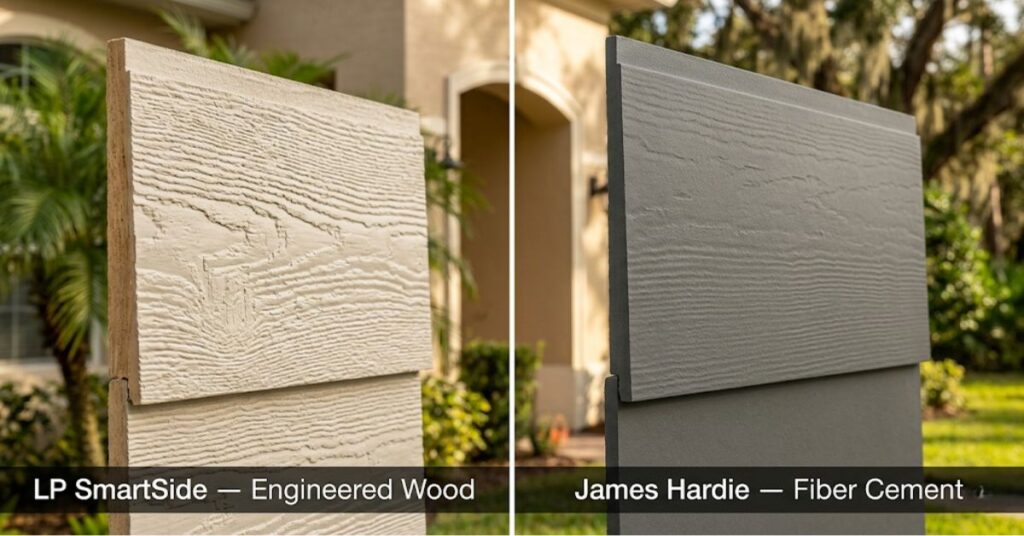
LP SmartSide is an engineered wood siding product manufactured by Louisiana-Pacific. It starts with wood strands and fiber that are combined with resins and wax binders, treated with a zinc borate preservative for pest and fungal resistance, and compressed into panels under high heat and pressure. The result is a product that looks and feels like wood but is engineered to be more dimensionally stable and resistant to rot than traditional wood siding.
LP SmartSide products come in a variety of profiles, lap siding, panel siding, trim, and soffit, and accept paint readily, giving homeowners flexibility in color selection. The 50-year warranty covers the product against fungal decay, termite damage, and manufacturing defects when properly installed and maintained.
What Is James Hardie Fiber Cement?
James Hardie fiber cement siding is manufactured from a blend of Portland cement, sand, and cellulose fiber. Unlike LP SmartSide, there is no wood-based material in the core composition. The product is non-organic, non-combustible, and inorganic, meaning it contains no material that moisture, salt, UV radiation, or biological organisms can degrade. James Hardie offers a full ecosystem of complementary products including lap siding, shingle panels, vertical panels, trim, and soffit, all engineered to their climate-specific HardieZone standards.
The James Hardie 50-year warranty covers rot, cracking, splitting, delamination, and pest damage, backed by the most established name in the fiber cement industry with decades of proven performance in coastal and high-humidity climates across the southeastern United States.
| 🔑 The Core DifferenceLP SmartSide is engineered wood, a dramatically improved wood product, but wood-based at its core. James Hardie is fiber cement, a fundamentally non-wood, non-organic material. In Florida’s extreme humidity, salt air, and hurricane environment, this core material difference drives meaningfully different real-world performance outcomes. |
Round-by-Round Comparison, What Matters Most for Tampa FL Homes
Round 1: Moisture & Humidity Resistance
Tampa Bay’s year-round humidity, averaging 74% to 90% relative humidity, is one of the most demanding conditions any siding material can face. How these two products handle that constant moisture exposure is one of the most important performance differences for Florida homeowners.
LP SmartSide’s zinc borate treatment provides genuine protection against fungal growth and moisture-driven decay, significantly better than untreated wood. However, the engineered wood core is still inherently moisture-sensitive at its edges and cut ends. When LP SmartSide panels are cut on site during installation, those exposed edges must be field-primed and sealed immediately. Any installation gap, improper caulking, or paint failure over time creates a pathway for Florida’s persistent humidity to reach the wood fiber core, where the borate treatment is thinnest. Over years of Florida’s humidity cycling, this moisture infiltration at vulnerable points is the most common cause of premature LP SmartSide failure we observe in the Tampa Bay market.
James Hardie fiber cement has no wood fiber at its exposed edges. Cement is cement, cut it and the material composition at that edge is identical to the face of the panel. There is no moisture-sensitive core to protect, no edge sealing requirement that can fail, and no organic material for Florida’s humidity to exploit.
| ✅ VERDICT: James Hardie wins clearly.In Tampa Bay’s persistent high-humidity environment, a material with no moisture-sensitive core is fundamentally better suited than one that requires perfect edge sealing to protect its wood fiber interior. Over a 20 to 30-year timeframe in Florida’s conditions, this difference becomes increasingly significant. |
Round 2: Hurricane & High-Wind Performance
Pinellas and Hillsborough County homeowners know that hurricane preparedness is not an abstract concern, it’s a practical reality of owning a home in Tampa Bay. Both LP SmartSide and James Hardie are engineered for wind resistance far beyond traditional wood or vinyl siding, but they approach it differently.
LP SmartSide panels have strong impact resistance and are tested to perform in high-wind environments. Their engineered composition provides better structural integrity than solid wood and their panel format can reduce the number of seams and potential wind entry points compared to lap siding profiles.
James Hardie fiber cement meets and exceeds Florida Building Code requirements for wind-driven rain and impact resistance, with products rated for winds exceeding 150 mph when installed per their HardieZone specifications. The inorganic, cement-based material does not delaminate, deform, or absorb wind-driven water in the way that any wood-based product can under sustained storm conditions. After major hurricane events across the Gulf Coast, fiber cement-sided homes consistently demonstrate superior exterior integrity compared to engineered wood-sided homes in equivalent wind zones.
| ✅ VERDICT: James Hardie wins, particularly for coastal Pinellas County homes.Both materials outperform vinyl and wood in wind events, but fiber cement’s non-organic composition and certified Florida Building Code performance give it a meaningful edge in Tampa Bay’s documented hurricane risk corridor. |
Round 3: Fire Resistance
This category is not close, and it’s more relevant to Florida homeowners than many realize.
LP SmartSide, as an engineered wood product, is combustible. It carries a Class 1 fire rating (also called Class A for surface burning) for flame spread and smoke development, which means it resists the spread of flame across its surface, but it will still ignite and burn when exposed to direct flame or sustained heat. In communities where homes sit close together, or in Central Florida areas increasingly affected by wildland fire encroachment, this matters.
James Hardie fiber cement is non-combustible, it will not ignite, will not sustain burning, and will not contribute to fire spread under any normal residential fire conditions. It carries a Class A fire rating not just for surface burning characteristics but because the material itself is incombustible. Some Florida home owner’s insurance carriers recognize this distinction and offer premium adjustments for homes with non-combustible siding.
| ✅ VERDICT: James Hardie wins, no contest.Non-combustible is a fundamentally different safety level than combustible with a good surface flame rating. For Florida homeowners in dense neighborhoods or near wildland interface areas, this distinction has real-world safety and insurance implications. |
Round 4: UV & Florida Sun Performance
With over 360 days of sunshine in Clearwater annually and UV indices consistently in the extreme range throughout Tampa Bay’s long summers, how siding holds its finish color and surface integrity under sustained UV exposure is critical to long-term appearance and performance.
LP SmartSide panels arrive primed and require field painting after installation. The factory primer provides a solid base for paint adhesion, and LP offers a finishing system with their own paint products. However, field-applied paint in Florida’s UV environment typically requires repainting every five to seven years to maintain appearance and protect the engineered wood substrate. Any paint failure, from improper application, incompatible paint products, or simply Florida’s aggressive UV over time, exposes the engineered wood surface to the moisture infiltration cycle described in Round 1.
James Hardie’s ColorPlus Technology applies the finish in a factory-controlled environment using a multi-coat, kiln-baked process that bonds directly to the fiber cement surface. The result is a 15-year factory finish warranty specifically covering Florida-level UV conditions. In our years of observing both products across Tampa Bay installations, ColorPlus Hardie siding consistently holds its color vibrancy and surface integrity years beyond what field-applied finishes on LP SmartSide achieve in equivalent sun exposure.
| ✅ VERDICT: James Hardie ColorPlus wins for Florida UV performance.A factory-kiln-baked finish on a non-porous substrate is inherently more UV-resistant than field-applied paint on an engineered wood surface. For Tampa Bay homeowners who want to avoid repainting, ColorPlus is the clear choice. |
Round 5: Salt Air & Coastal Durability
For homeowners in Clearwater, St. Pete Beach, Davis Islands, Harbour Island, or anywhere near Tampa Bay and the Gulf of Mexico, salt air resistance is a non-negotiable performance requirement.
LP SmartSide’s zinc borate treatment provides meaningful protection against many biological threats, but zinc borate is not a salt-resistance treatment. Salt air accelerates paint degradation on any surface, and on a wood-fiber substrate, once the paint film degrades, the underlying engineered wood becomes vulnerable to the moisture infiltration that salt-laden coastal air delivers constantly. LP SmartSide can perform well in moderate coastal environments, but in the high-salt-exposure zones of coastal Pinellas County, it requires more frequent maintenance attention than fiber cement.
James Hardie’s cement, sand, and cellulose fiber composition has no reactive metals, no wood fiber at exposed surfaces, and no material that salt air can chemically degrade. In high-velocity hurricane zones and coastal exposure categories defined by Florida Building Code, fiber cement’s coastal performance is simply unmatched by any engineered wood product currently available.
| ✅ VERDICT: James Hardie wins, especially for homes near the water.For any Tampa Bay home within visual distance of the Gulf or the Bay, fiber cement’s resistance to salt air degradation is a meaningful and lasting advantage over any wood-based siding product, regardless of how well engineered that product is. |
Round 6: Where LP SmartSide Has Real Advantages
An honest comparison requires acknowledging where LP SmartSide genuinely performs well and where it may be the right choice for certain Tampa Bay homeowners:
- Weight and Ease of Installation: LP SmartSide panels are lighter than fiber cement, which makes installation somewhat faster and reduces the structural load on the wall assembly. For certain home designs or renovation constraints, this can matter to the installation process.
- Impact Resistance Against Hard Strikes: Engineered wood has a degree of flex that fiber cement does not. In situations where a hard, localized impact occurs, a baseball, a falling branch, LP SmartSide is less likely to crack or chip than fiber cement. Fiber cement is hard and durable but can crack under sharp point impacts in a way that engineered wood does not.
- Color Flexibility: Because LP SmartSide is designed to be field-painted, homeowners who want a highly specific custom color not available in James Hardie’s ColorPlus palette have more flexibility with LP SmartSide. Field painting Hardie is possible but more involved than painting LP SmartSide.
- Performance in Non-Coastal Environments: In inland Florida markets farther from the coast and saltwater exposure, areas like parts of Polk County, Marion County, or northern Hernando County, LP SmartSide’s performance gap compared to James Hardie narrows considerably. In lower-humidity, lower-salt-exposure environments, LP SmartSide can be an excellent choice.
| 🔧 Our Honest Recommendation for Tampa Bay HomesFor the overwhelming majority of homes across Hillsborough, Pinellas, Pasco, and Hernando County, we recommend James Hardie fiber cement over LP SmartSide. Florida’s specific combination of coastal humidity, salt air, hurricane wind exposure, and extreme UV creates conditions where fiber cement’s non-organic composition provides a long-term performance advantage that becomes more significant with every decade the siding is on the home. LP SmartSide is an excellent product, just not the optimal choice for Florida’s coastal climate specifically. |
Who Should Choose James Hardie vs LP SmartSide in Tampa FL?
Despite our clear recommendation for most Tampa Bay applications, there are specific scenarios where LP SmartSide may be worth considering. Here’s the honest framework:
Choose James Hardie Fiber Cement If You…
- Live within several miles of the Gulf, Tampa Bay, or any saltwater body
- Are in a hurricane or tropical storm high-risk zone, which describes all of Pinellas and most of Hillsborough County
- Want to completely eliminate exterior painting for 15 or more years with ColorPlus
- Are in a neighborhood with high home values where premium exterior materials are expected, Hyde Park, South Tampa, Davis Islands, Palma Ceia, Clearwater Beach
- Plan to own your home for ten or more years and want a true permanent exterior solution
- Have an HOA with premium exterior material requirements
- Want the strongest possible fire resistance classification for your exterior
LP SmartSide May Be Worth Considering If You…
- Are well inland, away from coastal salt air and lower direct storm surge risk
- Need a lighter siding material for a specific structural or renovation reason
- Want a highly specific custom color not available in the ColorPlus palette and prefer field painting flexibility
- Are doing a shorter-term renovation on a rental property or flip in a lower-exposure Florida location
- Have had a specific positive experience with LP SmartSide from a prior project in a non-coastal climate
Frequently Asked Questions, LP SmartSide vs James Hardie in Tampa FL
Q: Does LP SmartSide hold up in Florida’s humidity?
LP SmartSide performs meaningfully better than traditional wood siding in Florida’s humidity, the zinc borate treatment, resin binders, and engineered construction provide real protection against the rot and fungal growth that would devastate solid wood. However, LP SmartSide’s engineered wood core remains moisture-sensitive at cut edges and any points where the paint system is compromised over time. In Tampa Bay’s persistent coastal humidity, this requires more diligent maintenance attention than fiber cement, which has no moisture-sensitive core material to protect.
Q: Is James Hardie harder to install than LP SmartSide in Florida?
James Hardie fiber cement is denser and heavier than LP SmartSide, which means installation requires experienced crews with the right equipment, including HardieBlade-equipped saws and proper lifting techniques for large panels. This is exactly why choosing a James Hardie Preferred Contractor matters: our crews install Hardie daily and work efficiently despite the weight difference. For homeowners, the installation complexity is entirely the contractor’s concern, your job is choosing the right material for Florida’s climate, not worrying about installation logistics.
Q: Do both LP SmartSide and James Hardie have 50-year warranties?
Yes, both products carry 50-year limited warranties. However, the warranty terms, conditions, and what they actually cover differ in important ways. James Hardie’s 50-year warranty is transferable to new owners and covers rot, cracking, splitting, delamination, and pest damage without requiring specific installer certification in all cases, though Preferred Contractor installation protects the full warranty. LP SmartSide’s warranty has specific installation, priming, and painting requirements that, if not followed precisely, can limit or void coverage. Always read the warranty documents carefully before signing any contract.
Q: Can LP SmartSide withstand Tampa’s hurricanes?
LP SmartSide engineered wood products are tested for high-wind performance and significantly outperform vinyl and traditional wood siding in hurricane conditions. However, fiber cement’s non-organic composition and certified Florida Building Code wind-driven rain performance give it a meaningful advantage in the documented hurricane risk corridor of Tampa Bay. For homes in Pinellas County and coastal Hillsborough areas, where direct storm impacts are a realistic concern, fiber cement’s proven performance record in post-hurricane assessments makes it the stronger choice.
Q: Which siding looks better, LP SmartSide or James Hardie?
Both products are available in profiles that closely mimic the look of real wood grain, and both look excellent when freshly installed and properly finished. The appearance difference becomes more pronounced over time in Florida’s climate. James Hardie’s ColorPlus factory finish maintains consistent color vibrancy for fifteen or more years without repainting. LP SmartSide’s field-applied finish begins showing UV fade and potential paint system wear in Florida’s conditions within eight to twelve years, requiring repainting to restore appearance. For long-term curb appeal in Tampa Bay, James Hardie sustains its premium appearance longer without owner intervention.
Q: Is Fresh Start Exteriors certified to install both products?
Yes, Fresh Start Exteriors is a James Hardie Preferred Contractor and can install LP SmartSide as well. That said, when a homeowner asks us directly for our recommendation for a Tampa Bay home, we consistently recommend James Hardie fiber cement for the climate-specific performance reasons outlined throughout this guide. We’ll always give you our honest professional opinion, and then install whichever product you choose with full craftsmanship and care.
| Still Deciding Between LP SmartSide & James Hardie?Talk to Tampa Bay’s veteran-owned siding specialists. We’ll assess your specific home, neighborhood, and goals, and give you an honest recommendation with no pressure.Serving: Tampa · Hyde Park · South Tampa · Palma Ceia · Davis Islands · Harbour Island · Clearwater · St. Petersburg · Wesley Chapel · Land O Lakes · Lutz & All of Tampa Bay📞 (727) 916-7304 | Fresh Start Exteriors Inc | Tampa, FL 33613 |